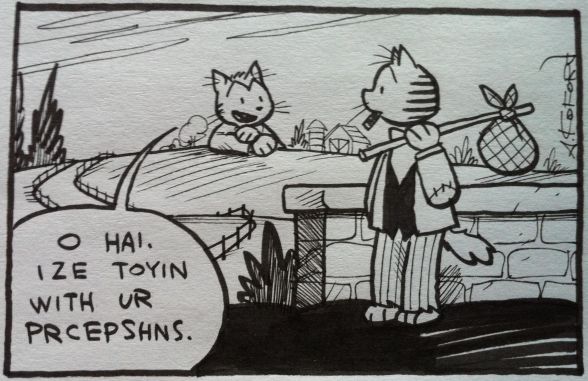
Fat Vampire: A Never Coming of Age Story, Rex. No. This came highly recommended, and has plenty of positive traits (two in particular: it’s mechanically sound, an incorrect “whomever” notwithstanding; and it has largely believable characterization), but it has two (to me) fatal flaws: it has way too much explanation, and it strikes me as far too interested in amassing geek credibility. These two characteristics combine particularly gratingly in the Rocky Horror scene, which walks us torturously through nearly every nuance of the viewing experience. Granted, plenty of plot and character advancement is occurring during the sequence, but I have to believe every bit of it could have been accomplished better without the artificial framework imposed by having it happen at a night out at a movie—especially when the author feels it necessary to explain so much of the night out.
This book would have been much better if Rex had worked harder on not telling us so much.
Monthly Archives: August 2011
Oysters + Boxes
While perusing menus at NYPL, I often came across an item called box stew in the same category as oyster stews. I now happen to run across mention of a specially-made oyster stew box in the magazine Table Talk, a sort of 1800s combination of a fine living magazine and a home hints column:
Oyster-stew boxes are a china novelty. The decoration, shells, sea weeds, and little marine views. They have fitted covers like bouillon cups.
How delightful! I wonder what the less-fancy ones looked like!
Explosionist Review
The Explosionist, Davidson. Yes. There were a number of features of this book that annoyed me: it’s nearly tiresome in the same ways that Jo Walton’s “Small Change” series was nearly tiresome (it is conceptually similar to Walton’s work, too); I discovered that I do not much care for the taint of outright fantasy in my historical speculative fiction; and there was this:
Dismissed, Sophie slipped upstairs just in time to avoid the inevitable awkward encounter with Miss Gillespie in the hall.
On the other hand, that sentence was the only time Davidson’s writing pulled me completely out of the story, and I found the characters believable enough, and some moments were quite well executed.
More spam observations
I occasionally mean to make reporting on the email spam we are rejecting a more regular feature, but then I occasionally mean to do a lot of things that never happen. So, here is another installment of a category I have just dubbed “Spiced Ham.” (note: according to Hormel, it is mere speculation that SPAM is a portmanteau of/for “spiced ham”)
Very little spam actually gets through the defenses of forcedperspective.org. We are able to achieve this relative impregnability primary through the use of the zen.spamhaus.org DNS Black list (I note in reviewing earlier spam observations that this is a reversal from the strategy of four years ago, which relied primarily on IP block banning. While we still ban many, many blocks of IPs, we have gone away from that as a primary defense because of the increasing usefulness of Zen and the very high levels of false-positives we were seeing). For instance, since Sunday, 49 of the 59 spam attempts we have blocked were by virtue of Zen. Of the rest, 3 were refused because the domain of the envelope From address did not exist, 1 because the domain of the envelope From address did not resolve (an interesting distinction), 1 because it originated from res.rr.com (this also would have been caught by Zen, but I preemptively block res.rr.com), and the rest were from countries I’ve banned (2 from India, and one each from Germany, India, Singapore, and Spain). We are able to get away with banning so many countries (65!) by virtue of two facts: first, we don’t get a lot of international traffic; second, (aside from Korea, China, and Bangladesh) banned countries get a soft (4XX) failure, instead of a hard one. This applies to all the other non-Zen blacklisting we do, too. Spammers almost never try again; legitimate senders almost always do. It really amounts to selective manual graylisting, because I choose to monitor what is being blocked in order to see if there are any false positives. I believe automated graylisting would probably work nearly as well, but I dislike the idea of delaying such a large proportion of the legitimate mail we get.
While a bunch of the search-engine traffic that hits the blog is because of my long-ago article Who is johnsmitsvt?, I have not seen spam attempts to that address in quite some time. This week, the only address that I am nearly certain has never existed on the system is elliott, which seems to have taken over as the new johnsmithsvt.
Updated to add: another thing I can recommend is creating an SPF record for your domain. It may be only a coincidence, but we have not experienced a back-scatter spam attack since we created one (with a default-discard (“~all”, not “?all”)).